
Trace every AI dollar to the work it paid for.
Today we’re launching Task Classification, a new Airia capability that sorts every AI prompt by the work behind it: coding, content generation, summarization, and the categories you define. Finance and AI leaders now see which users, agents, and projects drive AI spending, and exactly what kind of work that spending funds.
Task Classification runs at the Airia gateway, across every model provider you route through. It brings cost visibility down to the prompt level, inside the same platform you already use to govern AI traffic.
Find the work behind the bill
Traditional AI billing reports show how much you spend and which models you use. They say almost nothing about the tasks your employees and AI agents perform.
A monthly report can show spend on a frontier model doubling. It can’t show whether that money went to production code reviews or to employees summarizing their inboxes. Without that context, teams struggle to separate necessary spend from waste, and routine work keeps running on premium models.
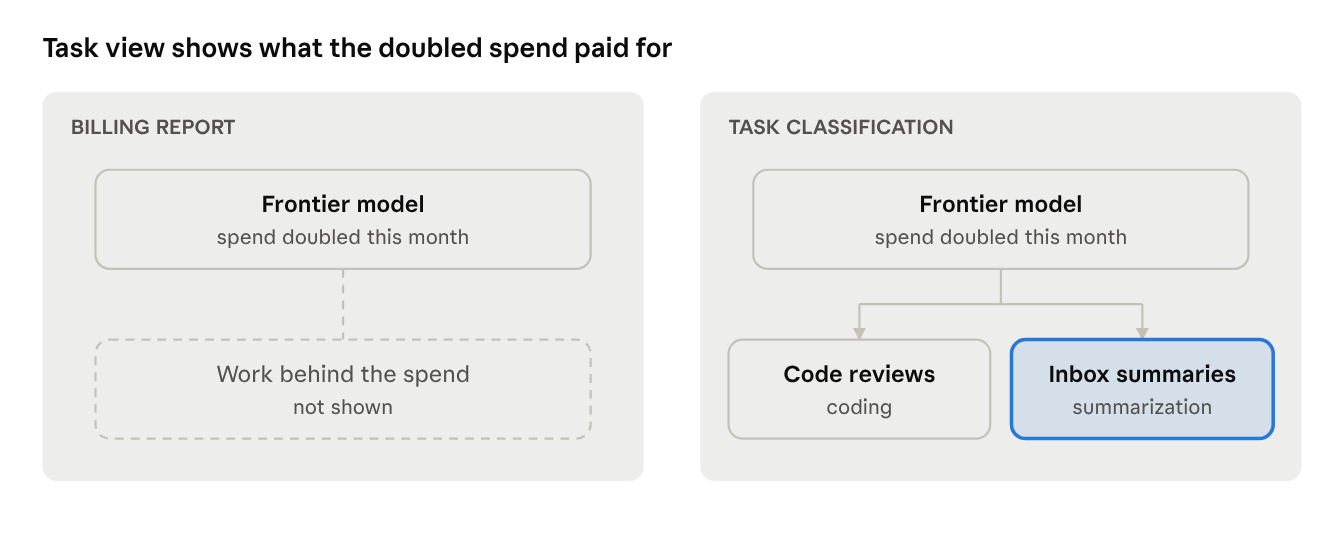 Billing report vs. task view · the same spend
To manage AI spend with confidence, leaders need three answers:
- Who drives the spend. The users, agents, and projects behind every request.
- What work it buys. The purpose of each prompt, tracked as a cost category.
- Where it can run leaner. Routine tasks that a lower-cost model can handle just as well.
Classify every prompt at the gateway
Task Classification sits where your AI traffic already flows. As each request passes through the Airia gateway, it analyzes the prompt, identifies its purpose, and tags it with a task category, regardless of which model provider handles it.
Those categories land alongside the reporting you already have on users, agents, and gateways. Spend becomes something you can read by person, by project, and by the type of work performed.
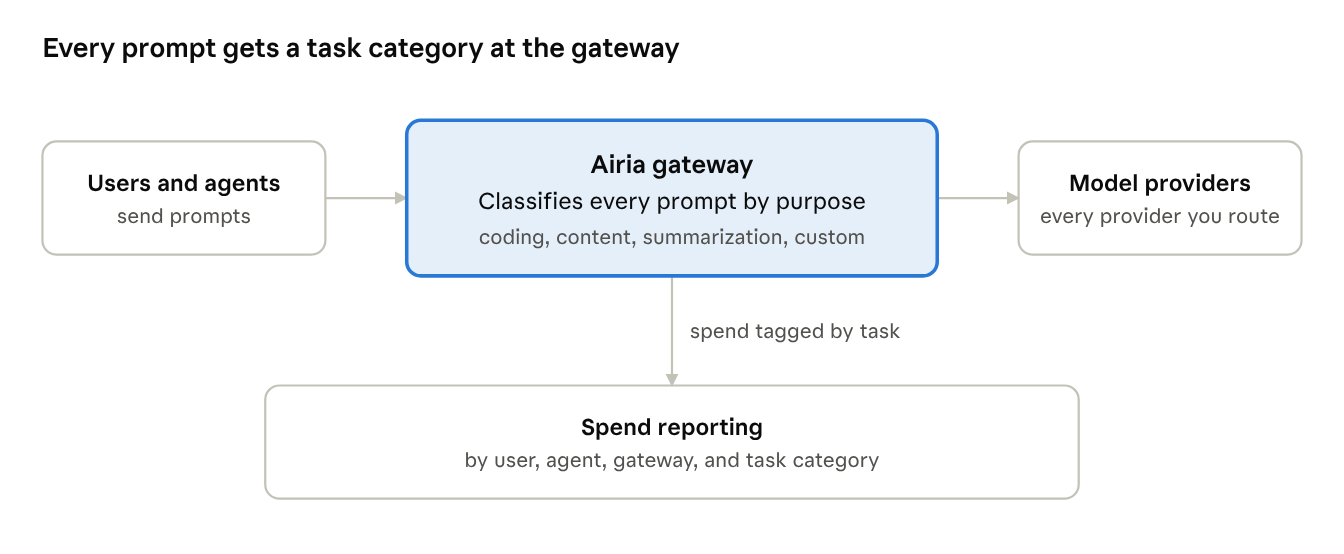 How Task Classification works at the gateway
“Enterprises have learned to count tokens. The harder question is what those tokens bought. Governing AI means understanding the work being performed, and Task Classification gives leaders that visibility at the prompt level, within the same platform they already use to govern AI traffic.”
Kevin Kiley, CEO of Airia
Read spend by the work it funds
Task Classification delivers three connected capabilities.
1. Classify prompts by purpose
Every request gets a task category based on what it asks the model to do. Categories include coding, content generation, and summarization.
2. Attribute spend to people, agents, and projects
Task categories sit next to your existing views of users, agents, and gateways. Finance sees which teams drive cost. AI leaders see which workloads justify a premium model and which don’t.
3. Define your own taxonomy
No two enterprises describe their work the same way. Create custom task categories that match how your business operates, then organize them into hierarchies. Email summarization rolls up into summarization, for example, so you can review spend at the summary level and drill into the detail when a number moves.
Trace a spending spike to its source
Here’s how it comes together in a hypothetical example.
A finance leader reviews monthly AI spend and sees summarization costs climbing. A billing report would stop there. Task Classification keeps going:
- Spots the category. Summarization stands out as the fastest-growing task category across the organization.
- Drills into the hierarchy. Inside summarization, email summarization accounts for most of the increase, while document and meeting summarization hold steady.
- Finds the source. Attribution shows the growth comes from one team’s agent, sending routine inbox summaries to a premium model.
- Points to the fix. Leaders now have a specific, defensible case: move that routine work to a lower-cost model and keep premium capacity for complex workloads.
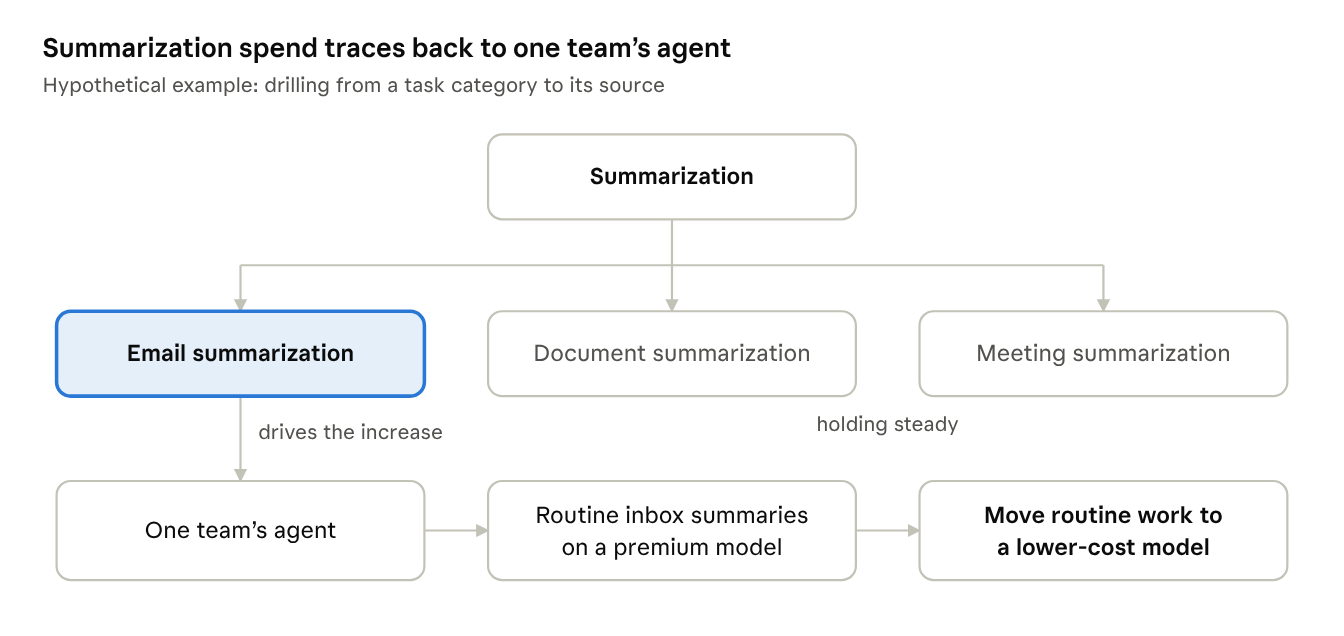 Drill-down from task category to source · hypothetical
The result: a vague line item becomes a clear decision, backed by evidence at the prompt level.
Route routine work to the right model
Task Classification shows where your AI spend goes today. Next, it will act on that insight.
- Conversation-level analysis. Classification will expand from single prompts to entire conversations, including threads that mix personal and business use.
- Task-aware routing. Task categories will feed directly into gateway routing policies. Routine tasks will go to lower-cost models automatically, and more capable models will stay reserved for complex workloads.
The same gateway that delivers visibility today will enforce policy-driven savings next.
Get started
Task Classification is available now to every organization routing AI traffic through the Airia gateway. See what your AI spend buys, down to the prompt.
- Read the announcement for the full release.
- Talk to our team about building a task taxonomy that fits your business.
See what your AI spend buys, down to the prompt. Request a demo to watch Task Classification sort your own AI traffic by task, team, and agent.
Put these ideas to work.
Schedule a 30-minute walkthrough with our team.