Govern every AI dollar.
Attribute every AI dollar to the people, teams, and agents behind it, enforce budgets inline, and route each request to the model the work needs, all on one AI FinOps platform.
Gartner says AI FinOps belongs in real time. Airia already runs there.
Gartner, Emerging Market Quadrant for AI FinOps Tools, Startup Vendors, October 2026.
Used by leading security and AI transformation teams
- KOA
- Northwestern
- ArcelorMittal
- BuzzFeed
- Learning Care Group
- Mars
Your AI bill arrives late.
Your teams run agents, coding tools, copilots, and model APIs, and each one bills somewhere different. Provider invoices land weeks after the money is gone. Dashboards show totals without causes. One agent run spans dozens of model calls, tool executions, and retries, and none of it appears as a line item.
Surprise bills.
A team runs up a large invoice, and finance hears about it after the money is spent.
Chargeback.
Every business unit and project needs its share of AI cost, and someone builds that split by hand.
Sprawl.
Copilots, coding tools, agent platforms, and model APIs each send their own bill.
Waste.
Frontier models summarize email, retry loops run for hours, and nobody sees which spend pays off.
- 98%
of FinOps teams now manage AI spend, up from 31% two years ago.
- #1
tool capability FinOps teams say doesn't exist today: granular monitoring of AI spend across tokens and LLM requests.
- 40%+
of agentic AI projects will be canceled by the end of 2027, with escalating costs among the reasons.
Gartner, June 2025
Trace AI spend from request to invoice.
Every AI request crosses one point before it reaches a model. That is where cost gets attributed, checked, and routed, while the money is still unspent.
Cap worst-case cost before launch.
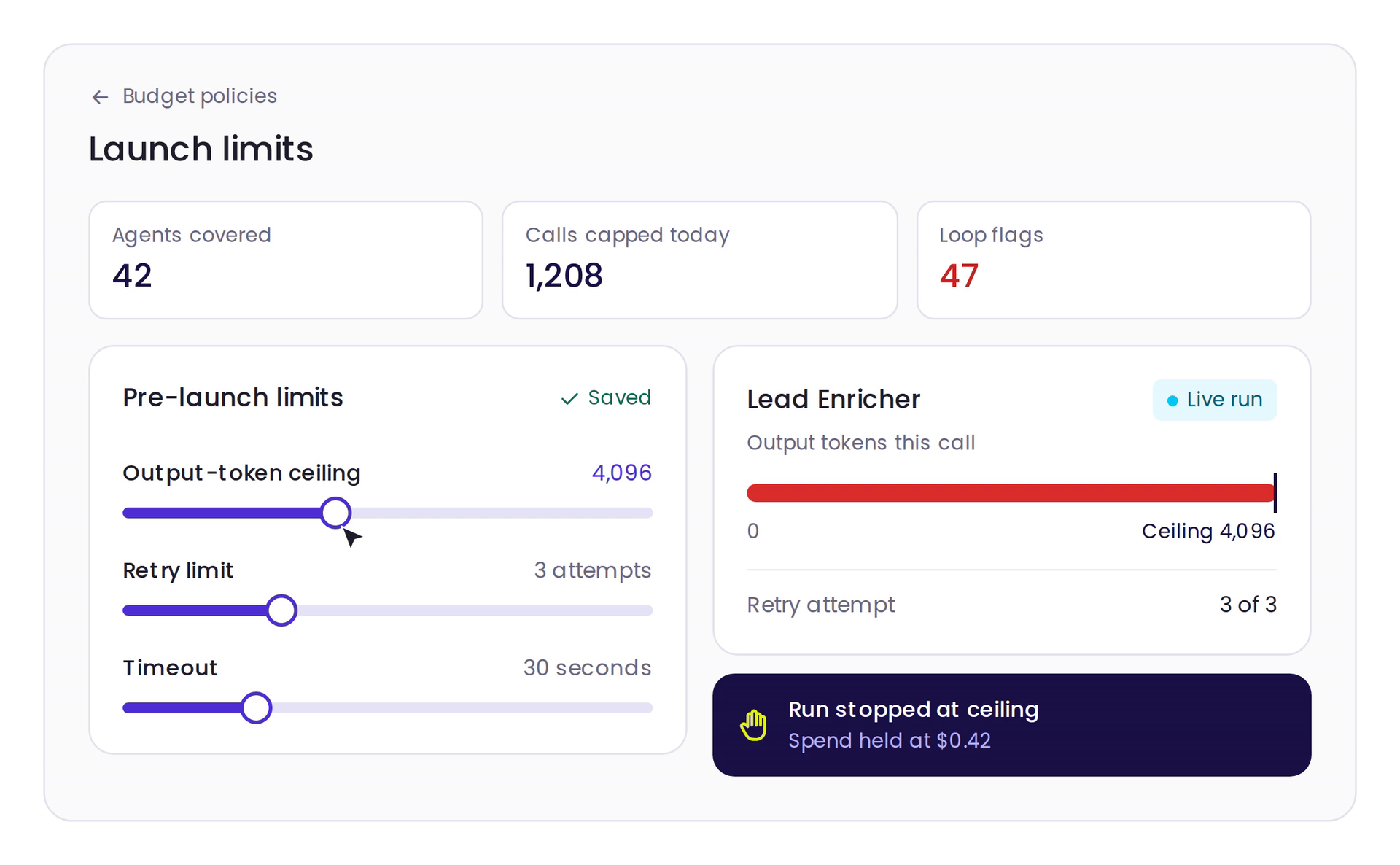
Set output-token ceilings, retry limits, and timeouts before an agent ships, so no single run can spiral.
Attribute every request.
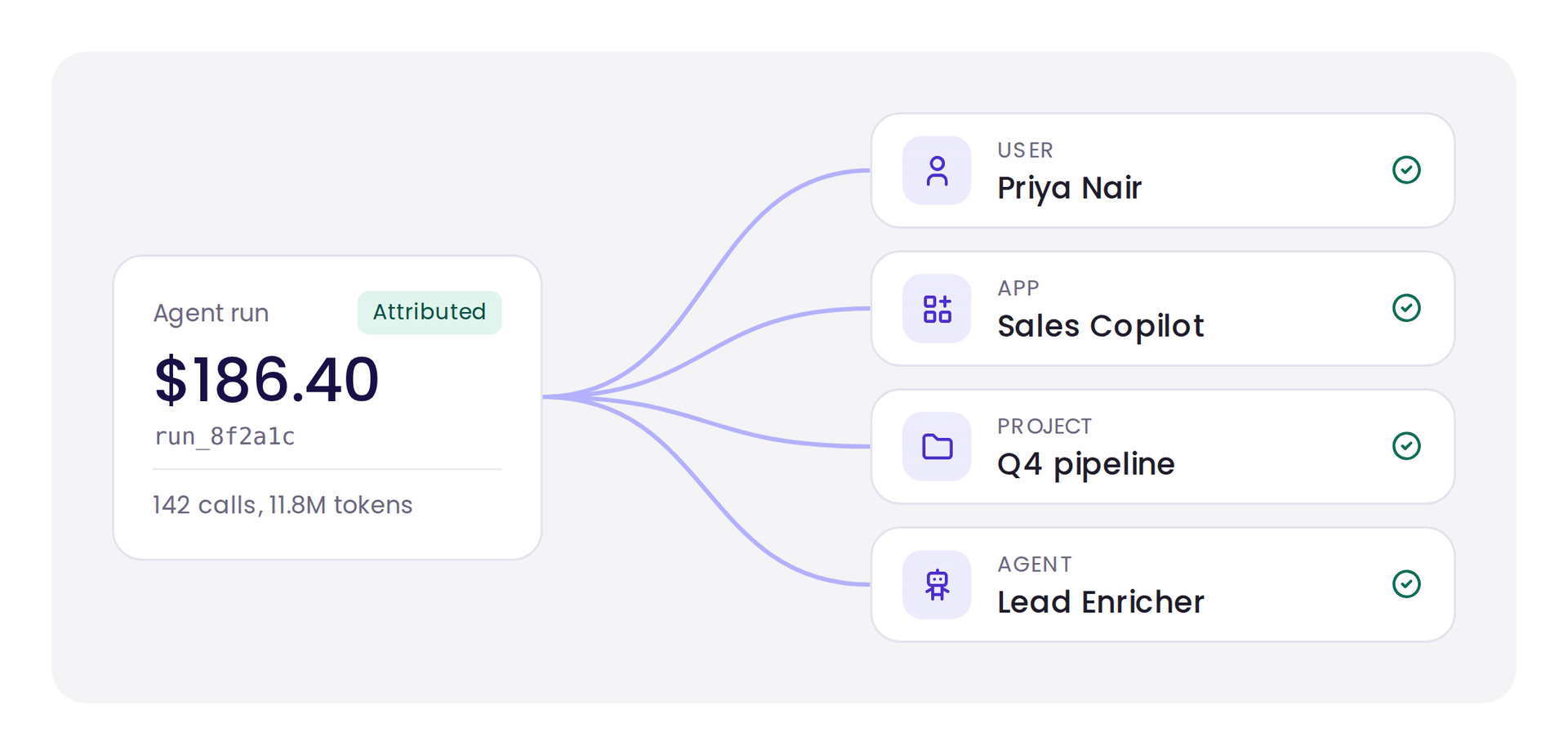
Tie each request to the user, app, project, and agent behind it, and map it to cost centers through your identity provider. Task Classification adds the work itself: code generation, summarization, or analysis.
Check the budget inline.
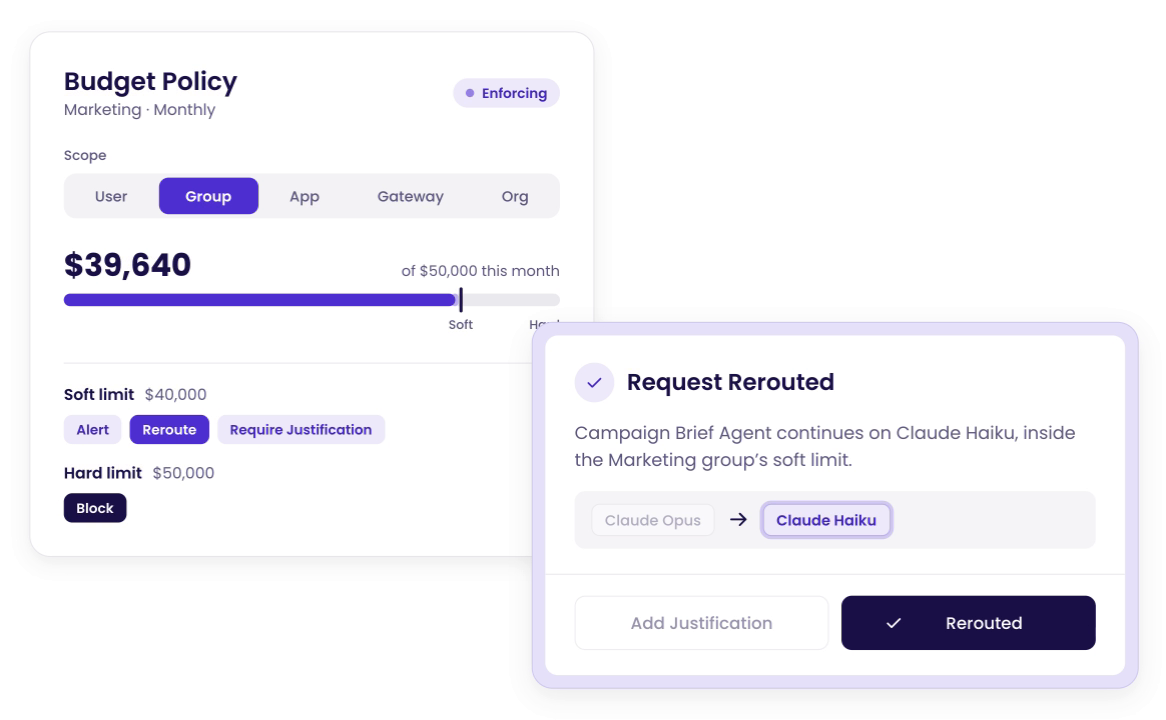
Enforce hard and soft limits by user, group, app, project, or organization. Alert, block, reroute, or require a justification in the same request.
Route to the model the work needs.
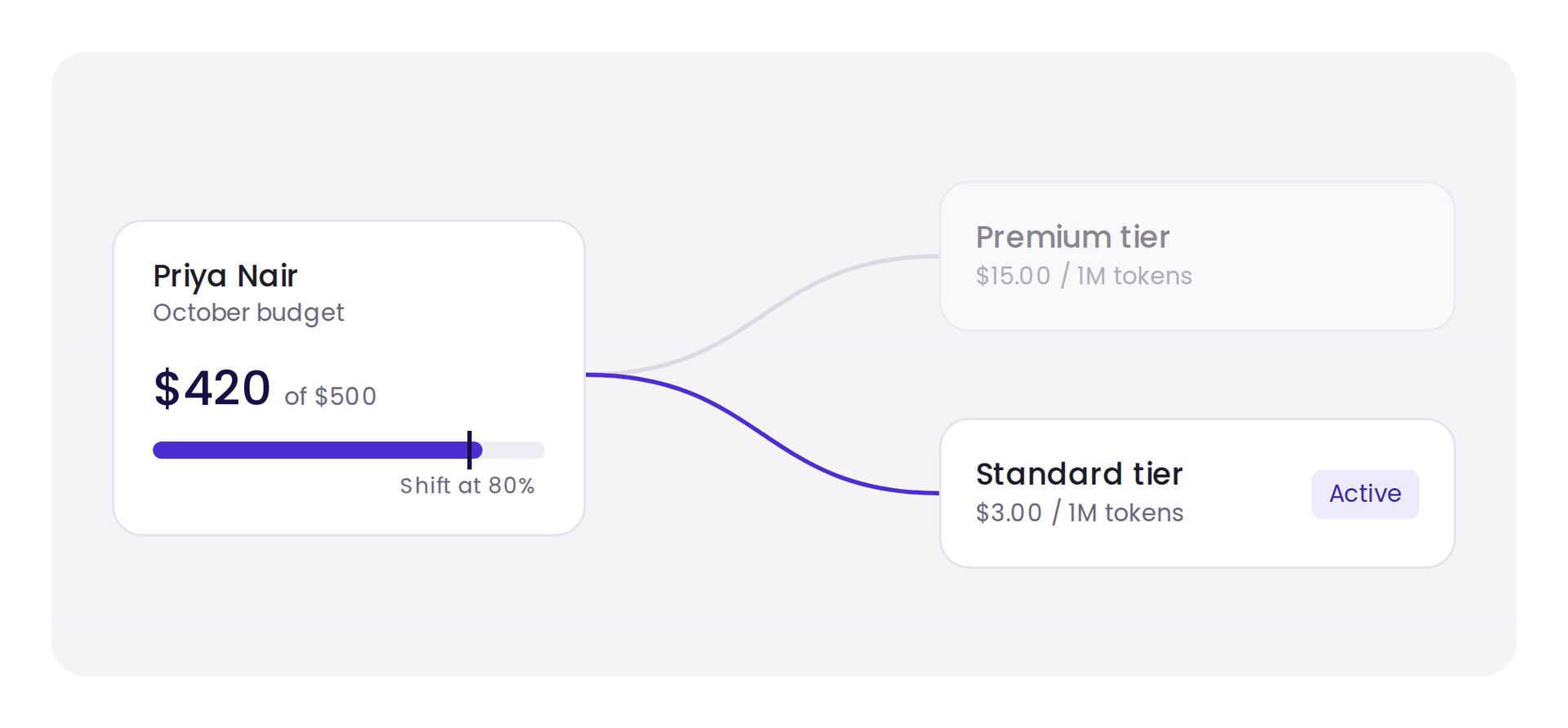
Send each request to the lowest-cost model that meets your quality bar, and shift users to a cheaper model as they near a threshold.
Reconcile to the invoice.
Match spend to provider invoices and export attributed spend in FOCUS format to the finance and FinOps tools you already run.
Stop spend at the limit.
An agent hits its team's budget on the 18th. The next request never reaches the model. The owner gets the alert, and finance sees the spend already attributed to the team and the agent. Visibility, attribution, and enforcement land in one moment, on one platform.
Finance sets the limit, the gateway holds it, and the record carries both.
- Spend attributed
- $40,000
- Cost center
- 4410
- Agent, user, and model
- On file
Account for every AI dollar.
Five AI FinOps capabilities carry spend from the first request to the finance report.
Budget Enforcement
Hold every team to budget.
Set daily, weekly, or monthly budgets by department, project, user, or gateway. Alerts fire before the cap, and a hard limit stops inference at it or at any threshold you choose.
Task Classification
See what the spend paid for.
Classify each request by the work behind it, so you know what code generation, summarization, and analysis each cost.
Model Routing
Match each use case to the model that fits it.
Route by task and complexity, set which models each team may use, and switch to a lower-cost model as spend nears a threshold. Compare agents side by side on quality, speed, and cost.
Cost Attribution
Give every dollar an owner.
Every agent run carries a dollar cost, rolled up by department, project, agent, user, and model provider and ready for chargeback. Agents built on other platforms get the same attribution when their requests run through Airia.
Agent Run Budgets
Price a full agent run as one unit.
Count every model call, tool, and retry in the run. Check the budget on every call, limit MCP tool calls per agent, and stop runaway spend early, whatever caused it.
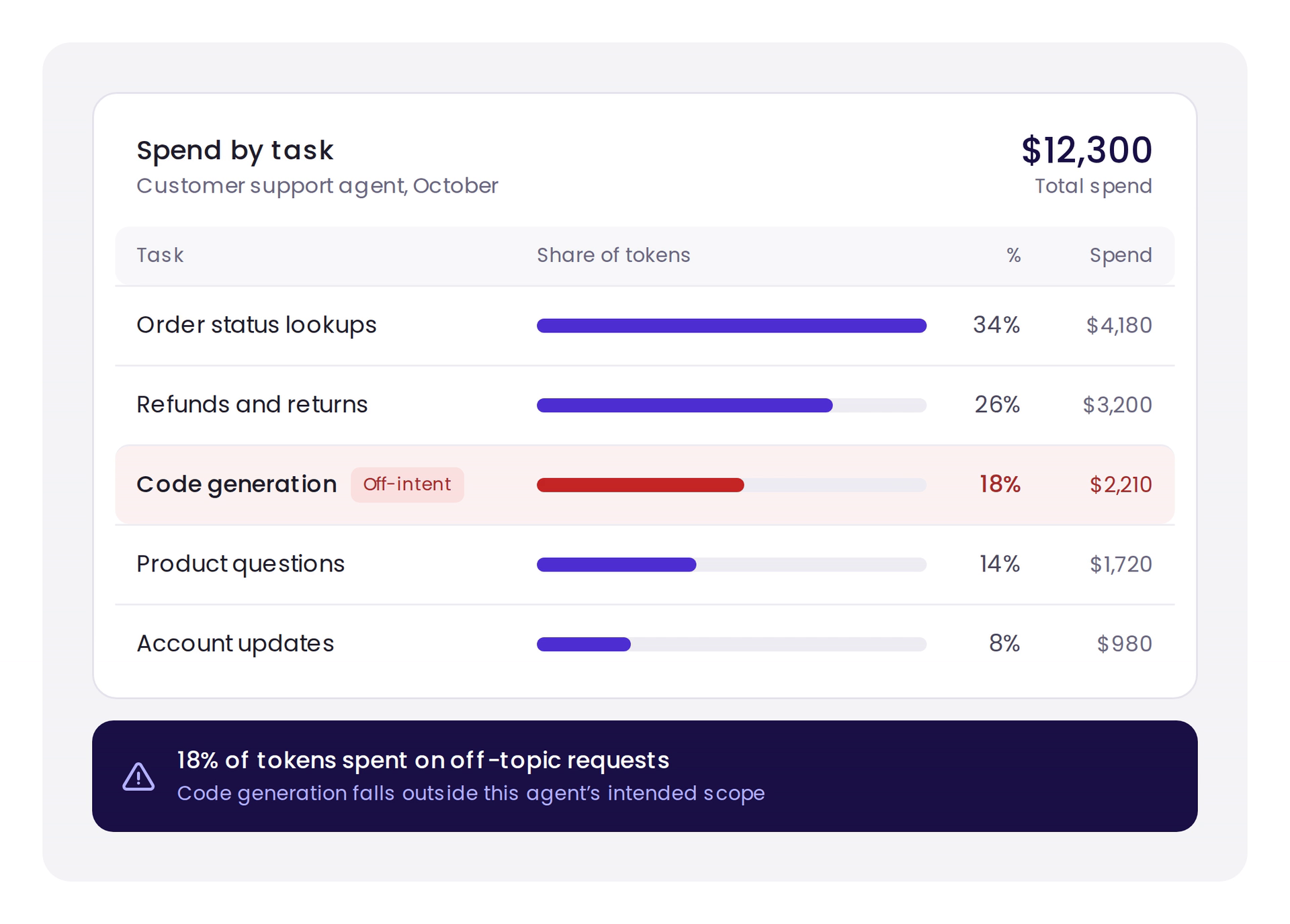
Price every kind of work.
Task Classification labels each request by the work behind it. See what each agent spends on every task, and catch the spend outside its intended scope.
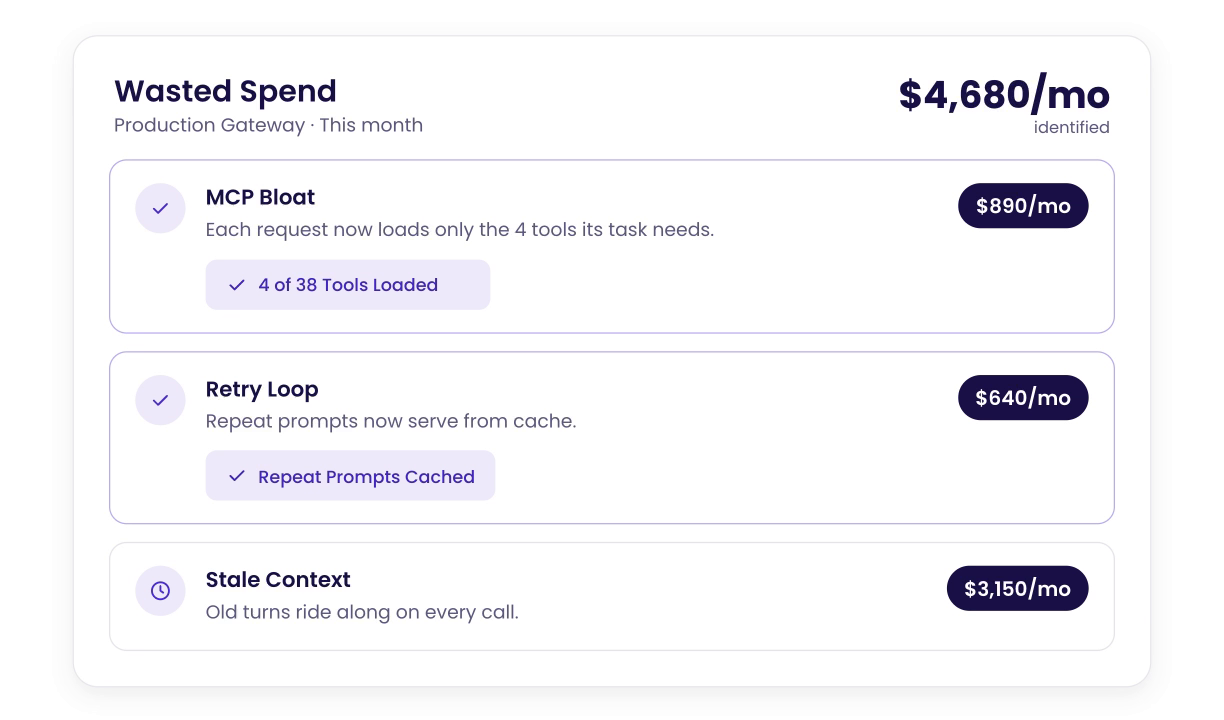
Find spend your invoices miss.
Some of the most expensive AI spend never shows up as a line item. Put a dollar figure on each source, then load only the MCP tools a task needs and cache repeat prompts.
Enforce budgets in the request path.
Out-of-band reporting
- Request goes out
- Model runs and bills
- Invoice lands weeks later
- Dashboard reports totals
- Money already spent
Airia, in the request path
- Request goes out
- Airia attributes the request
- Airia checks the budget
- Airia routes to the right model
- Spend stays inside the limit
Manage spend across your vendors.
Pay for the model the work needs.
See who uses which models and what each costs. Set the models each team, user, or project may use.
Put every seat on the right plan.
Find idle seats, duplicate subscriptions, and seats still billed for people who have left, starting with Claude. See the monthly savings from fixing each one.
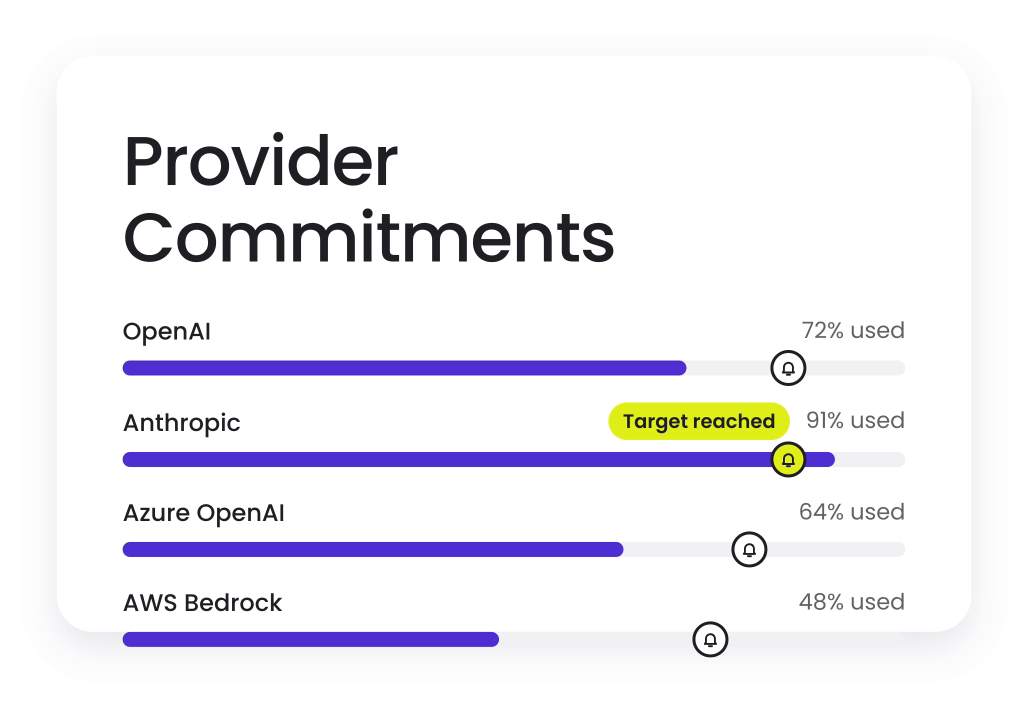
Use the commitments you already bought.
Track spend with every provider against your commitment targets, get alerts as you near each one, and route workloads to the provider with capacity left.
Run all of enterprise AI on one platform.
Cost belongs with the rest of your AI program. The same platform discovers shadow AI, governs every use case, secures agents and MCP servers, and enforces budgets, so finance, security, and AI teams work from one record. One platform also means one budget line and one team to run it.
Feed your finance stack.
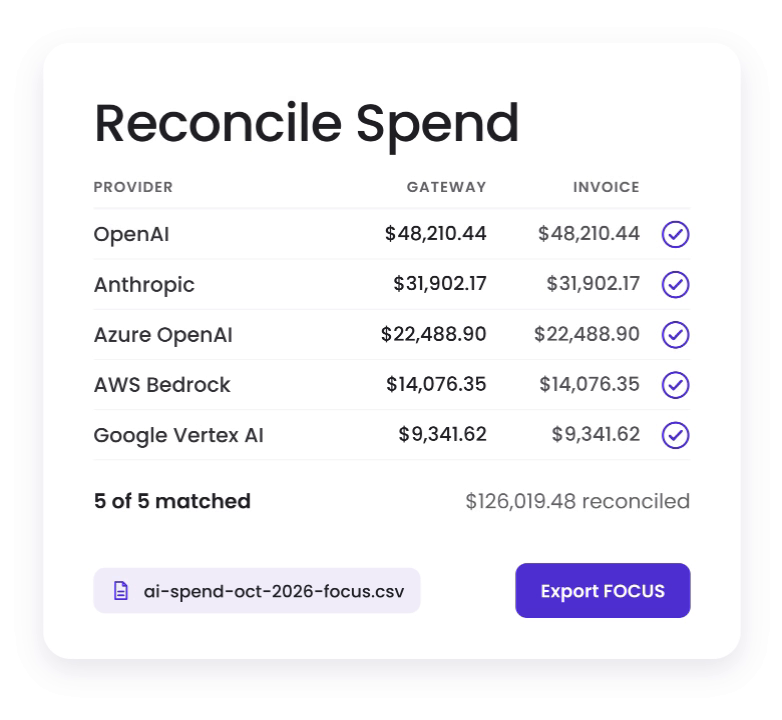
Airia works alongside your FinOps platform and finance ledger and supplies the request-level detail they can't see. Export attributed spend in FOCUS format, reconcile it to provider invoices, and send budget alerts to admins, users, Slack, or any system through a webhook.
See spend from your seat.
Track AI spend across tools.
See spend across every provider, model, agent, and team in one view, without stitching vendor dashboards together.
- Track spend by provider, model, agent, and team
- Set which models each team may use
- Retire idle seats and duplicate subscriptions
Charge back every AI dollar.
Every AI dollar lands with its cost center before the invoice arrives.
- Map spend to cost centers through your identity provider
- Run chargeback by department and project
- Reconcile to invoices and export in FOCUS format
Scale AI within budget.
Set the budget once, and the platform holds every team to it.
- Enforce budgets by team, project, and user
- Route each use case to the model that fits
- Compare agents on quality, speed, and cost
Get answers on AI FinOps.
Judge an AI FinOps platform on where it acts, what it attributes, and what it stops.
What is AI FinOps?
AI FinOps applies financial accountability to AI spend: who spent it, on what, and whether it stayed inside budget. Airia runs AI FinOps in the path of every AI request, so cost is attributed and budgets are enforced before the money is spent.
How does Airia differ from cloud cost tools?
Cloud cost and observability tools report AI spend after the provider bills it. Airia sits in the request path, checks the budget on every call, and can alert, block, reroute, or require a justification in the same request.
Does Airia replace our FinOps platform?
No. Airia works alongside the FinOps and finance tools you run and supplies request-level attribution they can't see. Export attributed spend in FOCUS format and reconcile it to provider invoices.
Can budgets block spend, or only alert?
Both. Set daily, weekly, or monthly budgets by department, project, user, or gateway. Alerts fire before the limit, and a hard stop can block inference at the cap or at any threshold you set.
Does model routing lower output quality?
You set the quality bar. Airia routes each request to the lowest-cost model that meets it, and you can compare agents side by side on quality, speed, and cost before you change a policy.
Can Airia attribute agents built on other platforms?
Yes. Agents built outside Airia get the same attribution by user, agent, department, and model provider when their requests run through Airia.
What does Task Classification add?
Task Classification labels each request by the work behind it, such as code generation, summarization, or analysis, so you see what each kind of work costs across teams.
What about AI spend outside the request path?
Requests that run through Airia get attribution and budget enforcement in the path. Spend that bills elsewhere still reaches the record: Airia tracks invoices, overages, and seat charges, starting with Claude, reconciles gateway spend to provider invoices, and tracks every provider against your commitment targets.
Gartner ranked Airia #1 for the AI Security Use Case in the 2026 Critical Capabilities for AI Governance Platforms.
Gartner named Airia in the Magic Quadrant for AI Governance Platforms.
Recognized by Forrester, Gartner, and IDC.
Stop unapproved AI spend.
Walk through your AI spend with our team, from the first request to the invoice.
Gartner, Magic Quadrant for AI Governance Platforms, Lauren Kornutick, Sumit Agarwal, Priya Sundararaman, Nader Henein, Brandon Medford, 17 June 2026.
Gartner, Critical Capabilities for AI Governance Platforms, Lauren Kornutick, Sumit Agarwal, Priya Sundararaman, Nader Henein, Brandon Medford, 17 June 2026.
Gartner, Emerging Market Quadrant for AI FinOps Tools – Startup Vendors, Ray Collins, Adam Ronthal, Marco Meinardi, Nitish Tyagi, 28 October 2026.
GARTNER is a trademark of Gartner, Inc. and/or its affiliates. Magic Quadrant is a trademark of Gartner, Inc. and/or its affiliates.
Gartner does not endorse any vendor, product or service depicted in its research publications, and does not advise technology users to select only those vendors with the highest ratings or other designation. Gartner research publications consist of the opinions of Gartner’s research organization and should not be construed as statements of fact. Gartner disclaims all warranties, expressed or implied, with respect to this research, including any warranties of merchantability or fitness for a particular purpose.